Correctness-Aware NL-to-SQL over OCEL Event Logs
The model proposes a typed plan; deterministic code decides whether it runs
Overview
A text-to-SQL system that fails loudly is easy to work with. The query names a column that does not exist, the database raises an error, and nothing downstream believes the result.
The failure that matters here is the silent one. On an object-centric event log, a query can join through the wrong path between business objects, execute cleanly, and return a plausible number that answers a different question than the one asked. No error is raised, because nothing in a normal stack is checking which path was taken.
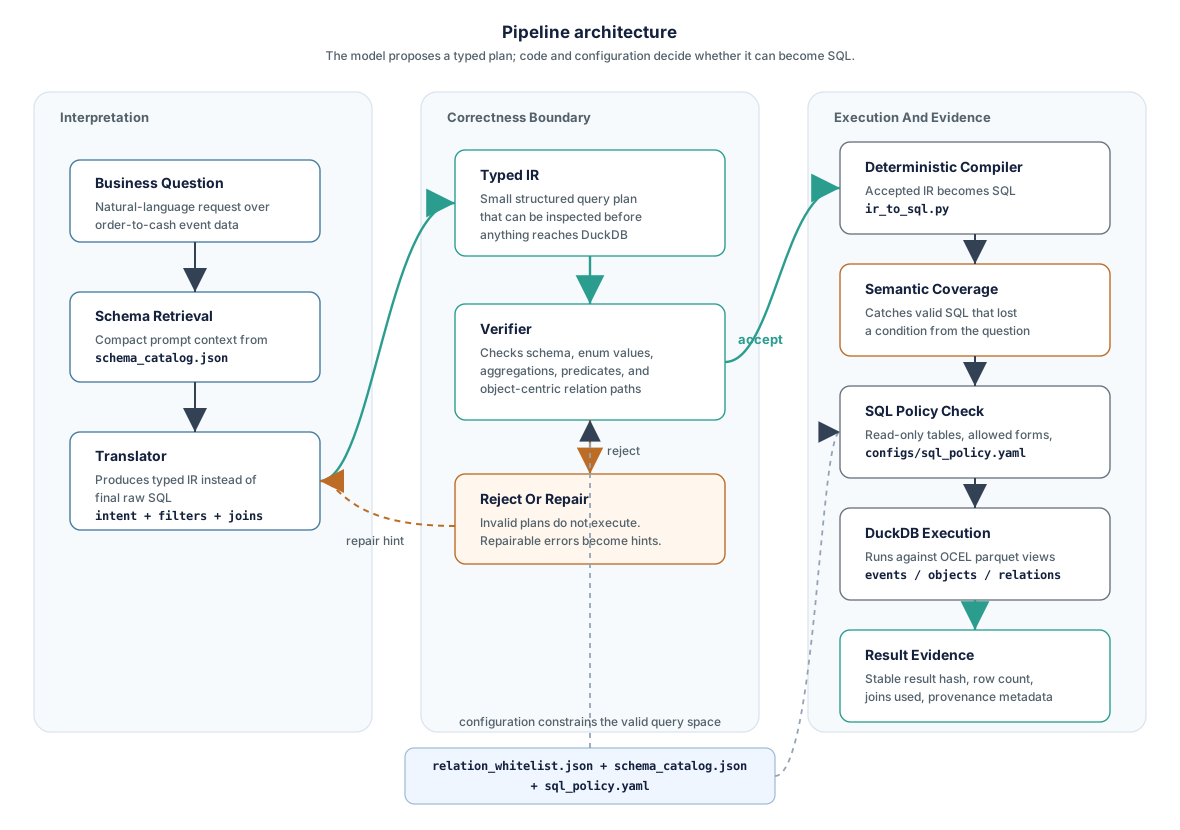
This project removes SQL generation from the language model. The model proposes a typed intermediate representation; deterministic code verifies that IR against a schema catalog, a relation whitelist and a SQL policy; and only then does a compiler assemble the query text. Anything the verifier rejects never reaches the database.
Measured against three published prompting strategies on the same backend and the same 120 questions, that architecture gains 23 points of denotation accuracy on the development split and holds relation-path violations at zero.
The Data Shape
The query target is an object-centric event log (OCEL 2.0) built from an order-to-cash process. A conventional event log flattens a process into one case per row, which forces a choice of single case notion and loses everything that does not fit it. OCEL keeps events, business objects, and the typed relations between objects as first-class records, so an order item, the customer it belongs to and the billing document it produced stay distinct and separately addressable.
The log is exposed to DuckDB as three views over parquet files.
| View | Contents |
|---|---|
events |
Event type, timestamp, and the object the event happened to. |
objects |
Order items, customers, billing documents, deliveries, AR items, materials. |
relations |
Typed links between objects, such as order_to_customer and billing_to_ar. |
The relations view is what separates this from a conventional text-to-SQL benchmark. There, the difficulty is finding the right columns. Here the columns are few and the difficulty is choosing the right path between objects:
order_item --order_to_customer--> customer --event--> dunning_raised
order_item --order_to_billing--> billing_doc --billing_to_ar--> ar_item
A question about customers who received a dunning notice needs the first path. A question about payment clearing needs the second. Both paths are joinable, both produce a count, and only one of them answers the question. Nothing about the result distinguishes them.
Why the Model Does Not Write SQL
The usual response is to strengthen the prompt: add the schema, add worked examples, add a self-correction pass. All three are represented in the baselines below, and all three still emit a SQL string that has to be trusted as written.
The alternative is to constrain what the model is allowed to produce. Its output is a typed plan in JSON, and never a query.
{
  "intent": "path_relation",
  "tables": ["objects", "relations", "events"],
  "select": [
    {
      "col": "object_id",
      "agg": "COUNT",
      "alias": "n_orders_with_dunning_customer",
      "distinct": true
    }
  ],
  "filters": [
    {"table": "objects", "col": "object_type", "op": "=", "val": "order_item"},
    {"table": "events", "col": "event_type", "op": "=", "val": "dunning_raised"}
  ],
  "joins": [
    {"relation_type": "order_to_customer"}
  ]
}
Structured this way, the plan is checkable by ordinary code. Whether order_to_customer is a real relation type, whether dunning_raised appears in the enum for event_type, whether COUNT DISTINCT is permitted for this intent: each is a lookup with a definite answer. The same questions asked of a finished SQL string require parsing it and inferring intent.
verify_ir returns one of three verdicts. accept passes the plan to the compiler. repair means the errors are fixable by substitution, so the specific violations go back to the model as hints and it tries again, up to two repair attempts. reject means the plan is structurally broken and the question is abandoned. Returning nothing is a better outcome than returning a number that cannot be justified.
Only after that verdict does any SQL text exist. ir_to_sql.py assembles the query from fixed clause builders and per-intent templates, with nothing generative involved, so the same accepted plan always compiles to byte-identical SQL. The compiler also refuses to emit a join for any relation type outside the whitelist, which means an illegal object path cannot survive compilation even if it had survived verification. DuckDB then executes that string against the three OCEL views.
What the Verifier Checks
Enforcement lives in configuration and code rather than in prompt wording.
| Layer | Where | What it rejects |
|---|---|---|
| Schema catalog | configs/schema_catalog.json |
Tables, columns, event types and object types that do not exist. |
| Relation whitelist | configs/relation_whitelist.json |
Joins along object paths absent from the log. |
| IR verifier | src/nl2ocel/query_verifier.py |
Invalid intents, predicates, aggregations and relation paths. |
| Semantic coverage | src/nl2ocel/semantic_coverage.py |
Schema-valid plans that drop a condition the question asked for. |
| SQL policy | configs/sql_policy.yaml |
Writes and DDL, unapproved base tables, aggregations and predicates, unbounded raw selects. |
| Result hashing | src/nl2ocel/result_hash.py |
Alias and row-order differences when comparing answers. |
The semantic coverage stage is the least obvious and catches a specific failure: a plan that is entirely valid against the schema but has quietly lost part of the question. A query about order items linked to customers who received a dunning notice can compile perfectly while counting all customer-linked order items. It runs, it returns a number, and the dunning condition has vanished. That check runs after compilation and before execution.
A Worked Example
One of the benchmark questions:
How many order items are linked to a customer that received a dunning notice?
The accepted plan compiles to:
SELECT COUNT(DISTINCT o.object_id) AS n_orders_with_dunning_customer
FROM objects o
WHERE o.object_type = 'order_item'
  AND EXISTS (
    SELECT 1
    FROM relations r
    JOIN events e ON e.object_id = r.to_object_id
    WHERE r.from_object_id = o.object_id
      AND r.relation_type = 'order_to_customer'
      AND e.event_type = 'dunning_raised'
  )
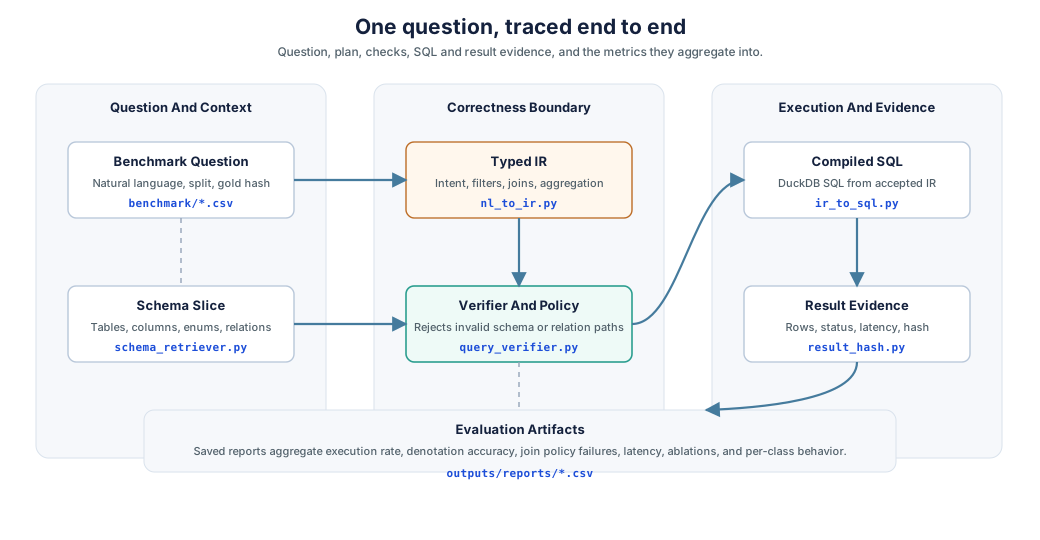
The relation_type filter is present because the compiler refuses to emit a join for a relation absent from the whitelist. Execution returns one row, which is hashed and compared against the stored gold hash for that question.
Each stage keeps its artifact: schema slice, IR, compiled SQL, status, latency, result hash. An answer can be taken apart afterwards.
Evaluation
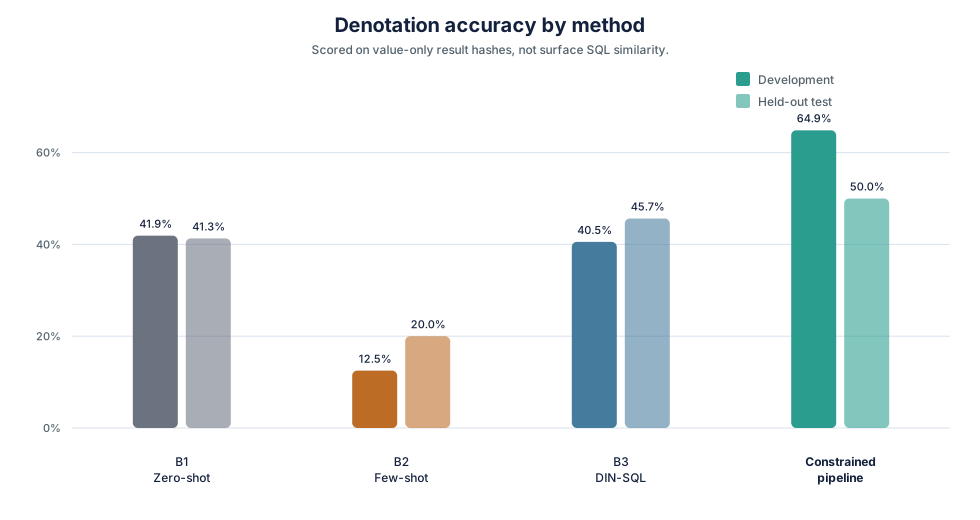
Answers are scored by denotation: execute the generated SQL, hash the returned values, compare against the gold hash. Resemblance to a reference query string counts for nothing, and two queries with no textual similarity that return the same table are both correct.
The baselines are three published prompting strategies, run on the same backend so the comparison reflects architecture rather than model quality. B1 is zero-shot Create Table + Select 3 prompting (Rajkumar). B2 is few-shot with similarity-diversity example selection (Nan). B3 is the four-stage DIN-SQL flow (Pourreza).
They are reimplemented here rather than approximated, which is most of the work in the comparison: nan_sampler.py builds B2’s demonstration pool by balancing question similarity against structural diversity and excludes its own seed questions from scoring, and din_sql_demos.py carries B3’s staged demonstrations with per-stage token caps and stop sequences. A baseline that loses because it was implemented carelessly proves nothing, so the effort went into making them hard to beat.
| Split | Method | n | ExecRate | DenAcc | JoinHall | Avg latency |
|---|---|---|---|---|---|---|
| Dev | B1 Zero-shot | 74 | 86.5% | 41.9% | 1.4% | 2.1s |
| Dev | B2 Few-shot | 72 | 100.0% | 12.5% | 0.0% | 43.9s |
| Dev | B3 DIN-SQL | 74 | 66.2% | 40.5% | 0.0% | 10.0s |
| Dev | This pipeline | 74 | 86.5% | 64.9% | 0.0% | 3.3s |
| Test | B1 Zero-shot | 46 | 93.5% | 41.3% | 0.0% | 2.2s |
| Test | B2 Few-shot | 45 | 100.0% | 20.0% | 0.0% | 40.1s |
| Test | B3 DIN-SQL | 46 | 73.9% | 45.7% | 0.0% | 10.3s |
| Test | This pipeline | 46 | 78.3% | 50.0% | 0.0% | 3.3s |
On the development split the margin is 23 points over the strongest baseline. On the held-out split it is 4.3 points, and with 46 questions the bootstrap interval is 50.0% [34.8%, 65.2%], which overlaps B3 substantially. The development result is a real effect; the held-out margin is not one to defend at this sample size.
B2 is the most instructive baseline. It executes every question and gets 12.5% of them right, which is the failure this project is about in its purest form: fluent, executable, wrong. It also takes 43.9 seconds per question.
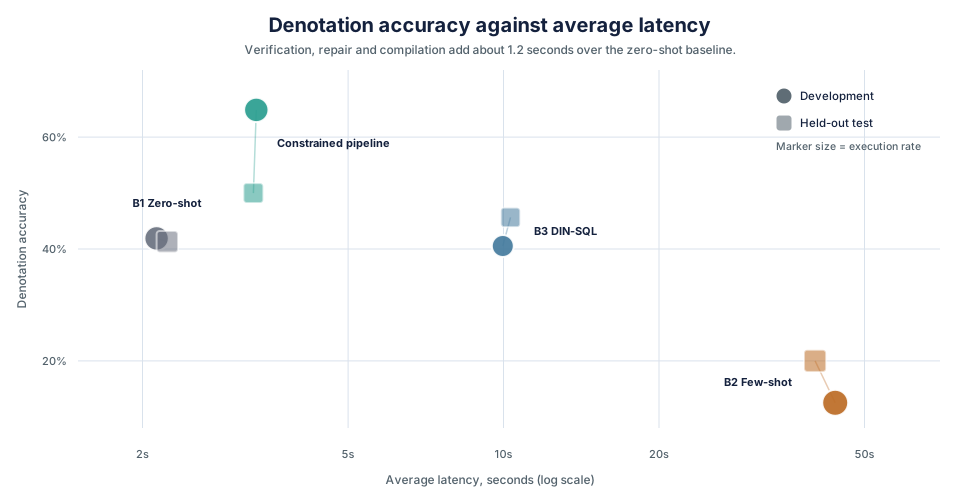
Latency matters because a correctness layer nobody is willing to wait for does not get used. Verification, repair and compilation add about 1.2 seconds over the zero-shot baseline.
Greedy decoding at temperature = 0.0 in src/nl2ocel/llm_client.py. Default token cap 2048; B1 uses 200; DIN-SQL uses 600 for stages 1–3 and 350 for self-correction, with stage stop sequences.
120 questions across nine query classes, split 74 development and 46 held-out test. B2 excludes its own demonstration seed questions from scoring, which is why its n is smaller.
Bootstrap confidence intervals use 10,000 resamples at seed 42. McNemar’s test compares the pipeline against each baseline on paired per-question outcomes.
ExecRate is whether the SQL executed. DenAcc is whether the result hash matched gold. JoinHall is the share of queries using a relation type outside the whitelist.
Changing the Translator
The baseline comparison shows the architecture beating prompting on one backend. A separate question is whether the guarantees belong to the architecture or to that particular model. The pipeline was rerun with three translators, holding the verifier, whitelist, policy, compiler, evaluator and split fixed.
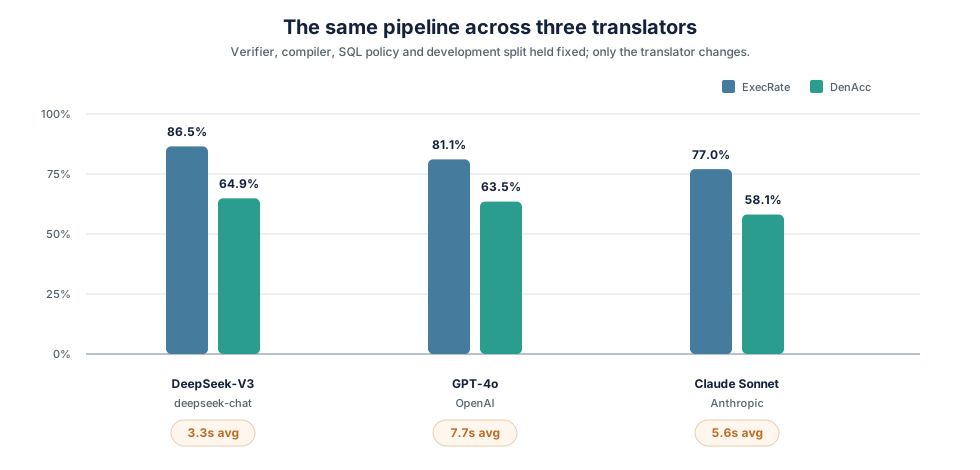
Accuracy differs between backbones. Relation-path violations stay at zero in all three runs, which is the property the whitelist exists to provide. It holds because the check is a program, not an instruction the model may or may not follow.
The Ablation
Removing the verifier raises denotation accuracy on the development split.
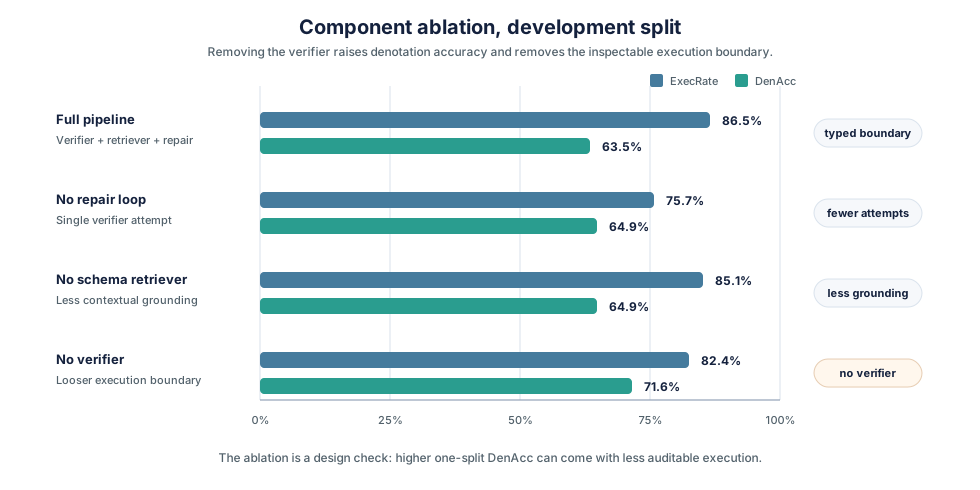
The verifier is conservative. Some plans it rejects would have executed and returned the right answer, and on this benchmark that costs measurable accuracy: 71.6% without it against 63.5% with it. (The ablation is its own run, so its full-pipeline figure sits slightly below the 64.9% in the comparison above.)
The verifier stayed in. The higher-scoring variant cannot report which relation path produced an answer, cannot refuse a question it should not attempt, and offers no typed plan to inspect afterwards. Its advantage is a few points on one split; its cost is that every answer has to be taken on faith. For a system whose output feeds financial reporting, that is the wrong trade, and the number that argues against the design belongs in the write-up either way.
Where It Fails
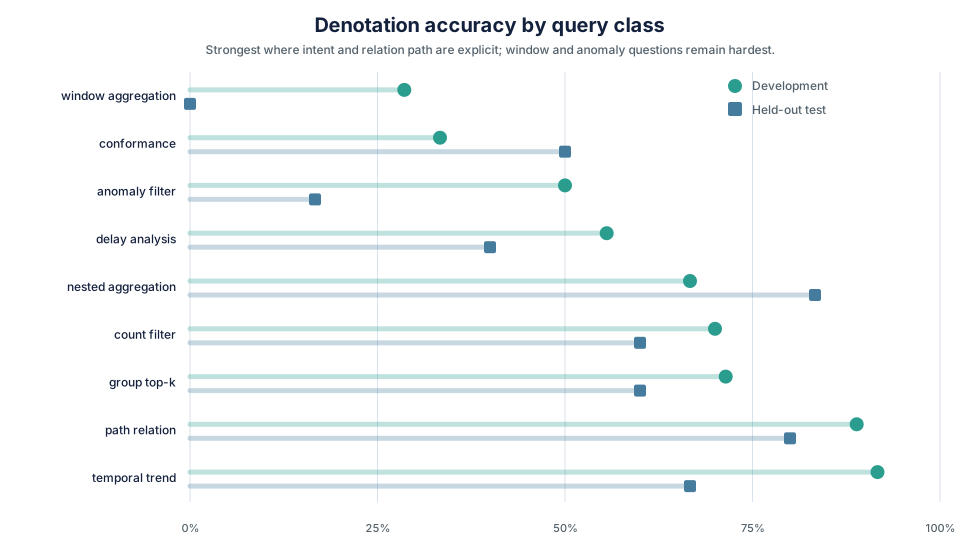
Accuracy is highest where typed intent carries the most information: temporal trends at 91.7% on development, path-relation questions at 88.9%, and nested aggregation.
It is weakest on window aggregation (28.6% development, 0% held-out) and anomaly filters (50% and 16.7%). Rolling windows, negation over absent downstream activity, and delay thresholds computed from a distribution rather than given as a constant are all things the compiler has no form for, so a sensible plan can arrive and still have nowhere to go.
That was my assumption about the failures generally, and hand-classifying a sample of twelve of them by root cause did not support it. Only one was a compiler error and one a failed repair. The rest were translation choices that nothing structural could catch: three multi-hop joins aggregating at the wrong grain, two queries reading the wrong table, two selecting a relation that is whitelisted and legal but not the one the question meant, plus a hallucinated column, a hallucinated event type, and an inverted anti-join.
The distinction decides what is worth building next. A whitelist can refuse a path that does not exist. It cannot know that order_to_billing was the wrong legal choice for this particular question, because both the schema and the policy are satisfied either way. Closing that gap means the semantic coverage check reasoning about more of the question than it does today, which is a harder problem than writing more compiler templates.
Two caveats on that sample. Twelve is a fraction of the roughly fifty failures across both splits, and it was classified by hand rather than by rule. It also contains no window-aggregation questions, so the weakest class in the chart above is precisely the one it cannot explain.
Limits
Seven of the 120 benchmark questions match hardcoded semantic templates in pipeline.py and bypass the model entirely, taking a known-good IR shape directly: four in the development split and three in the held-out split. They still pass through the compiler and the relation whitelist, but they do not exercise translation. Excluding them from the development split leaves the pipeline around 62.9%, still well clear of the 41.9% baseline, so they are not what produces the result. They are worth knowing about when reading it.
The benchmark also carries paraphrase duplicates: distinct questions that resolve to the same gold SQL. Scoring once per unique gold template instead of once per question pulls the pipeline down from 64.9% to 60.6% on the development split, while the two strongest baselines drift up by a point or two. scripts/benchmark_dedup_analysis.py measures this. Part of the headline margin therefore comes from question families the pipeline handles well being counted more than once. The advantage survives deduplication, at roughly 60.6% against 42.4%, but it is narrower than the top-line table implies.
Beyond that: nine query classes over one schema shape and one process, and a held-out split too small to separate methods that finish within a few points of each other. Widening the compiler is the first task, and growing the benchmark is the second, because the current one cannot settle the questions it raises.
The transferable part is smaller than the project. Where generated code reaches something consequential, a typed representation between the model and the system turns “trust the output” into a check that either passes or does not. The model still does the interpretation, which is what it is good at. It does not decide what runs.
From Query Safety to Building Agents
This project is read-only, but it points at a larger problem. A query is already a bounded action: it selects data, follows a schema path, produces evidence, and can influence a decision outside the database.
The pattern that transfers is the boundary around the model. The model proposes a typed structure; deterministic code checks schema, relation paths, SQL policy and evidence before anything runs; and the result leaves a trace that can be inspected later.
That is why this work naturally leads into building agents over enterprise data. Once a system can take more than one step, the same failure gets sharper: a wrong join or missing condition early in the chain can make the final answer look coherent while hiding where it went off course. Multi-step systems need the single-step discipline first.
If the proposed step changes data rather than reading it, evidence is no longer just evaluation material. It becomes a precondition: what permissions applied, what rows supported the action, whether approval or rollback is required, and what audit record survives after the decision.
So the lesson here is deliberately modest: do not make the model the authority. Let it interpret and propose; let checked code decide what can run. This project works that out for SQL over an object-centric event log. Building agents is the broader version of the same design pressure.
Code, benchmark, verifier configuration and saved evaluation runs are in the repository. The analysis behind these figures is in 03_results.ipynb, the baseline runs in 02_evaluation.ipynb, and the schema profiling in 01_ocel_schema_exploration.ipynb.